‘Terms of Respect’: Eisgruber’s book is opening new avenues to share what colleges get right on free speech and academic inquiry
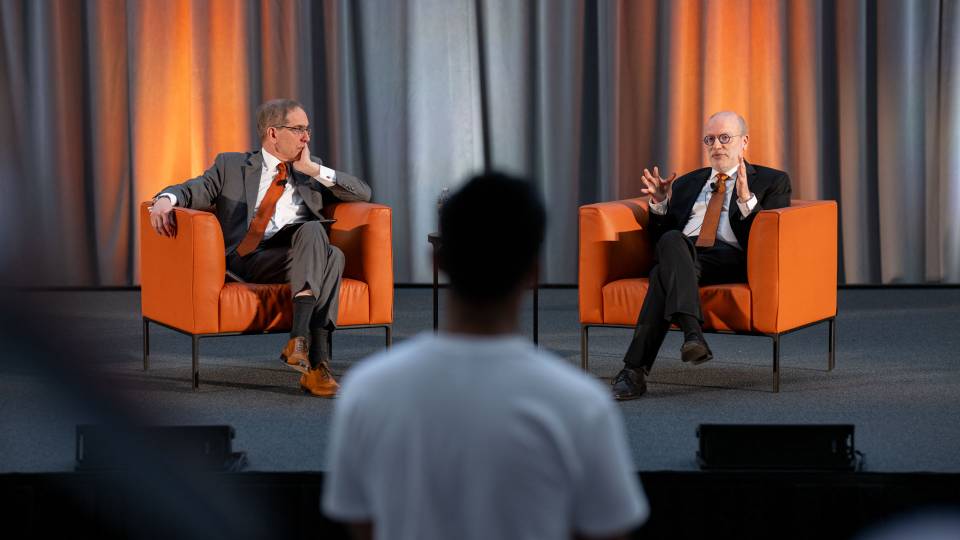
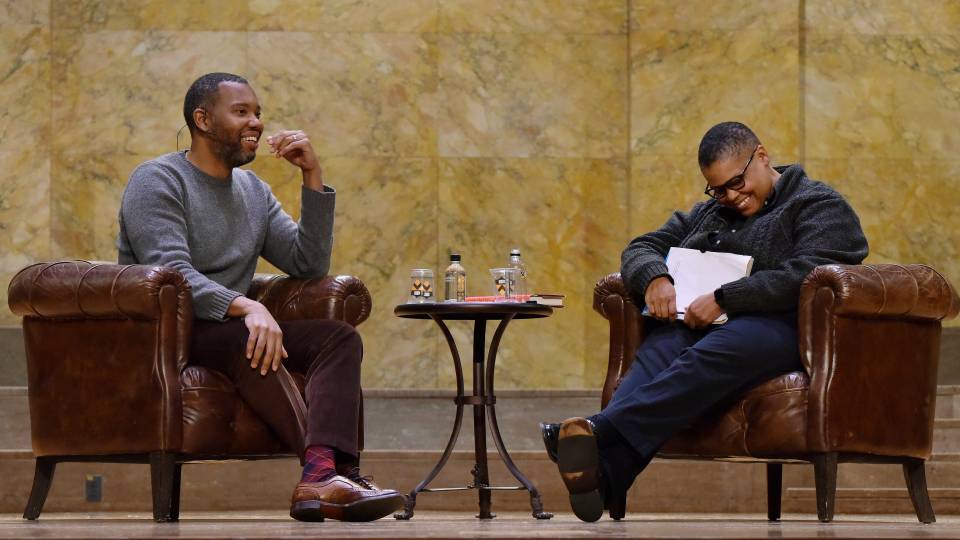
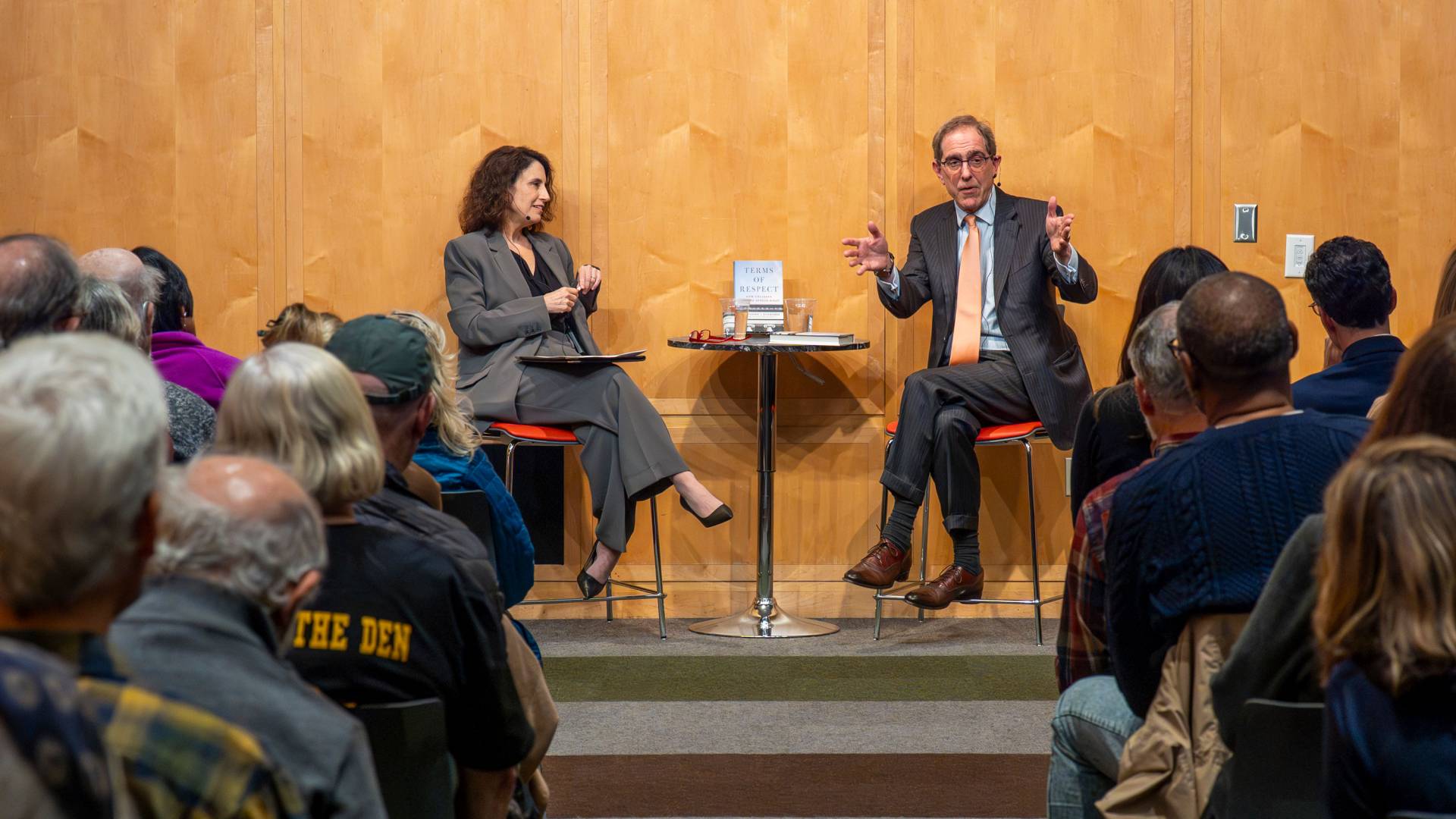
Princeton president Christopher L. Eisgruber (left) joins Ayesha Rascoe of NPR in conversation at the Princeton SPIA DC Center in Washington, D.C. Eisgruber has been using his book “Terms of Respect” as a platform to counter misperceptions about free speech and academic freedom.
In a talk last month for a Beltway crowd at the Princeton SPIA DC Center, President Christopher L. Eisgruber joined Ayesha Rascoe of NPR’s “Weekend Edition Sunday” for a spirited conversation about issues in American higher education.
Is it true, Rascoe asked, that today’s college students are “fragile flowers who can't deal with anything challenging their preconceived notions”?
Eisgruber said that his experience with Princeton students is the opposite.
He told the audience about a student who had once invited him to give a talk to a liberal student group, the Progressive Law Society. The organizer said he had also invited the Federalist Society, a conservative law group on campus. “He said, ‘We’re going to ask the students from the Federalist Society to ask you the first question because here in the Progressive Law Society, that’s our tradition. We want the conservative students to ask the first question.’
“When I talk to students, they’re interested in engaging with other ideas,” Eisgruber told the Washington audience. “I actually think they’re very strong and…in my view being valiant.”
Indeed, he said, claims "that colleges were inhospitable to free speech or that students were hiding from scary ideas rather than wanting to encounter opinions different from their own” were a key driver for writing his new book, “Terms of Respect: How Colleges Get Free Speech Right.” In his experience, those claims didn’t ring true.
Eisgruber has been using “Terms of Respect” as a platform to counter misperceptions about free speech and academic freedom — and to speak out on behalf of the essential role that Princeton and America’s research universities play in American democracy and society.
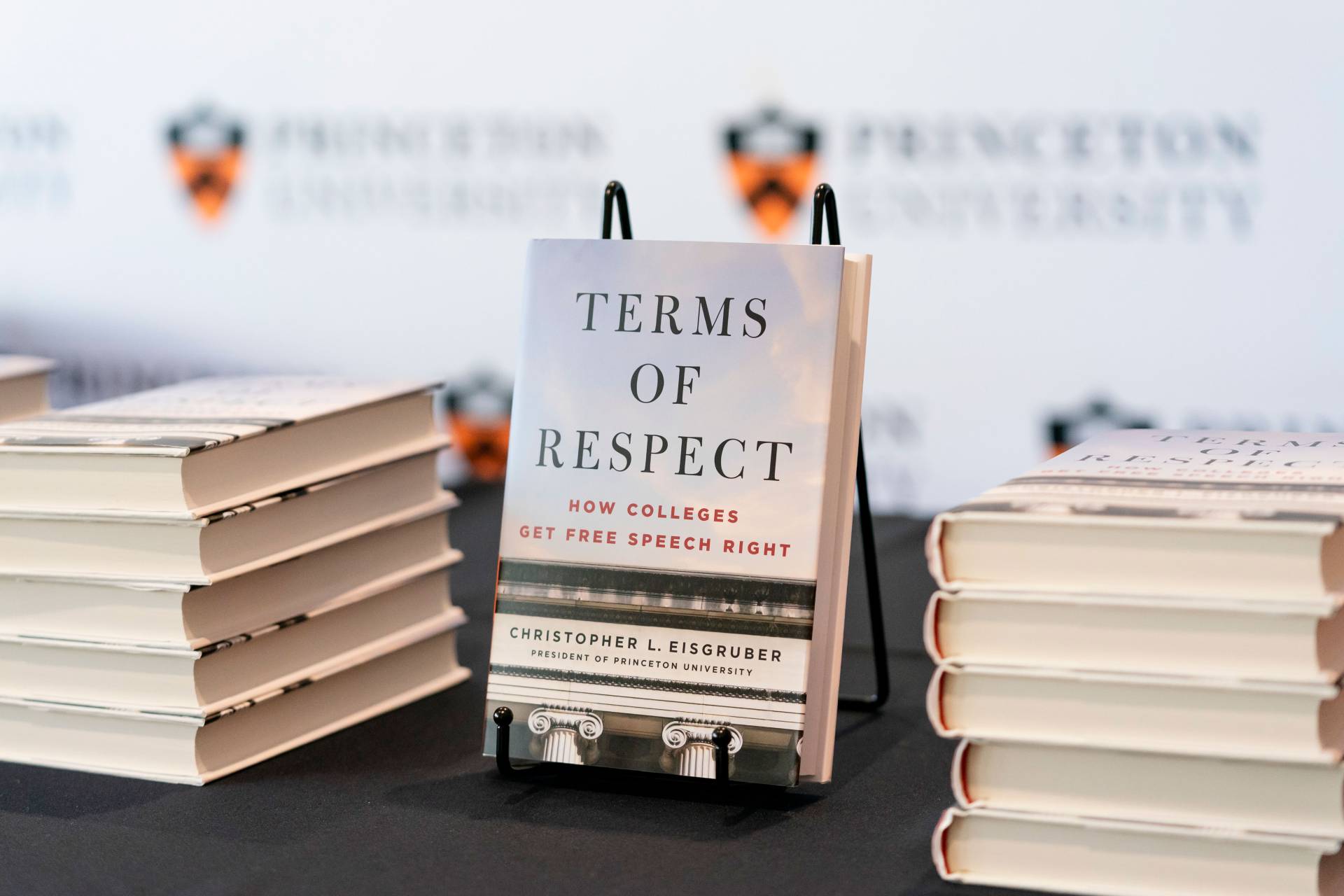
In book talks locally and nationally, Eisgruber’s message has been clear: The challenges surrounding free speech at Princeton and on college campuses are not occurring in an ivy-covered bubble but are reflective of a larger civic crisis in America today.
Speaking up for Princeton and America’s research universities
Since the book was released at the end of September, Eisgruber has brought his message to “CBS Sunday Morning,” “PBS NewsHour,” “Fareed Zakaria GPS” on CNN, the Financial Times, The Atlantic, Time Magazine and a range of other international, national and regional outlets.
Eisgruber has spoken at live events in Princeton, New York, Chicago, Washington, D.C., Cambridge, Mass., and other cities. More appearances are planned.
Most recently, he brought the book’s scholarly argument to the new Princeton University Art Museum, in a talk sponsored by the University Center for Human Values.
“The principal reason that American universities are being attacked is not because they have departed from their mission but because they are faithful to it,” he told an audience of faculty, staff and students.
“They’re being attacked because they protect the independence and academic freedom of their students and scholars. They’re being attacked because they pursue ideas and theories unsettling or unwelcome to those in power. They’re being attacked because they have pushed hard to achieve a diverse, equal and inclusive society that the United States Constitution envisions and that justice requires.
“We should take great pride in these universities, in these institutions that are at once marvelous and upsetting and we should defend them zealously,” he said, eliciting lengthy applause.
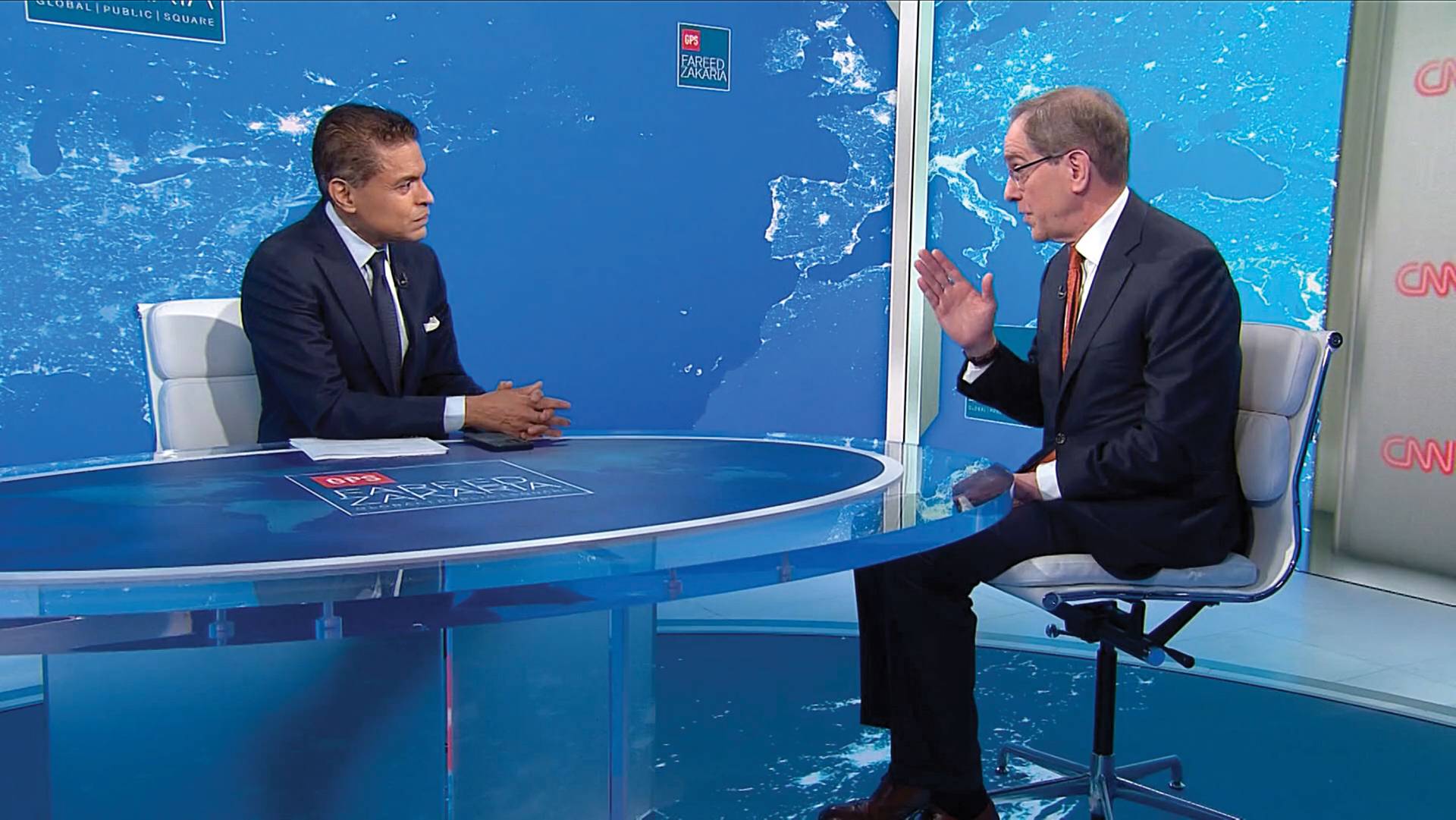
Since the book was released at the end of September, Eisgruber has brought his message to “CBS Sunday Morning,” “PBS NewsHour,” “Fareed Zakaria GPS” on CNN (pictured here), the Financial Times, The Atlantic, Time Magazine and a range of other international, national and regional outlets.
Addressing “a genuine civic crisis”
Whether walking across campus with Robert Costa for “CBS Sunday Morning” or addressing a live audience at the recent Chicago Humanities Festival, Eisgruber’s message is clear: The challenges surrounding free speech at Princeton and on college campuses are not occurring in an ivy-covered bubble but are reflective of a larger civic crisis in America today.
On Oct. 20, in a talk to a capacity crowd in the Princeton Public Library community room as part of his national book tour for “Terms of Respect,” he set the stage by reading an excerpt.
“Today’s young people are much like the rest of us,” he read aloud. “They want to engage with diverse viewpoints, and when they fail to do so, it’s usually because of characteristics they share with the rest of American society,” most prominently political polarization and potential fallout from social media.
“Those conditions affect all of us,” he continued. “America is confronting a genuine civic crisis. It is visible on, but neither confined to nor caused by, our college campuses.”
In the book, Eisgruber talks about the prevalence of self-censorship in the U.S., citing a 2020 study by political scientists that found that 46% of Americans feel less free to speak their minds than they used to be — in contrast to 13.4% of people who said they felt less free to speak their minds during the height of the Red Scare.
“Here's one statistic that I particularly find gripping on this, which comes out of a poll that Johns Hopkins did about a year ago,” he told the library event’s moderator, Deborah Pearlstein, director of the Princeton Program in Law and Public Policy. “About half of Republicans, and likewise, half of Democrats, think that people in the other political party are downright evil.
“That’s the phrase that was used in the poll,” Eisgruber said. “Now, if you know that there is a significant probability that somebody may judge you to be downright evil if you disclose your political views to them, you have an incentive to self-censor, right?” The prospect of an exchange going viral on social media only adds fuel to the fire.
Protests are an outgrowth of the same malaise, he said. Reading from the book, he told the audience: “Protest, agitation and dissension are — on campuses or elsewhere — signs of civic distress. They occur when more orderly forms of discussion have broken down or proven unsatisfactory.
“They are also, however, something more positive,” he continued. “They are instances in which people are speaking up rather than remaining silent, advocating for their vision of justice, and seeking change. That insight is essential to understanding the state of free speech on college campuses and the role of universities in American civic life.”
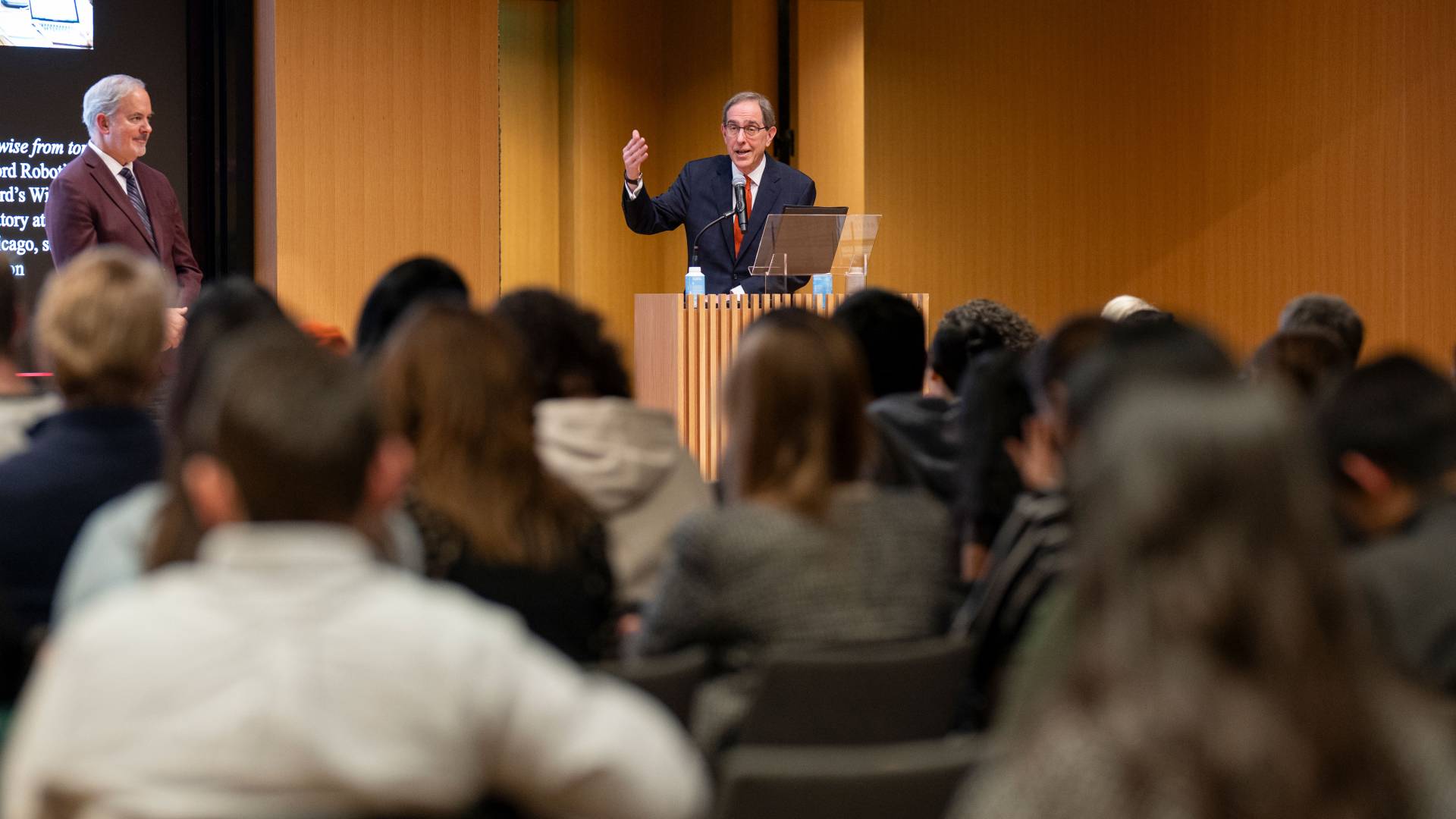
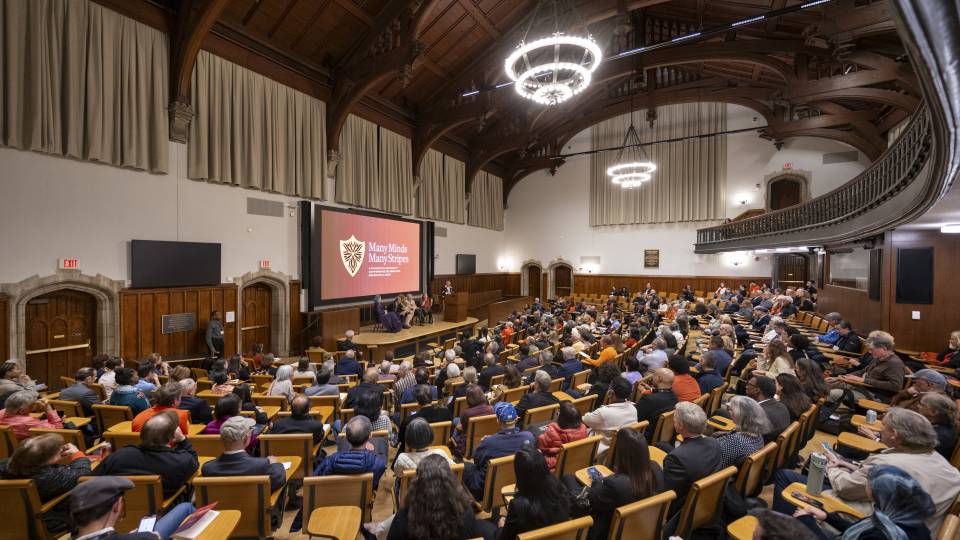
Princeton politics professor Stephen Macedo (left) introduced Eisgruber at a Nov. 19 book talk at the new Princeton University Art Museum. "The principal reason that American universities are being attacked is not because they have departed from their mission but because they are faithful to it,” Eisgruber told an audience of faculty, staff and students.
Where free speech rankings get it wrong
One of the concerns that Eisgruber has raised in his talks and media appearances is the way that free speech on college campuses is being measured — and in his view, mismeasured — by groups like the Foundation for Individual Rights and Expression (FIRE), which publishes annual free speech rankings that he says “too often code controversy as though it were equivalent to censorship.”
In Washington, NPR’s Rascoe asked him to elaborate.
A couple of years ago FIRE ranked Harvard University “dead last” and Princeton “not high,” Eisgruber said, while Michigan Technological University was ranked No. 1. A FIRE spokesman told the New York Post he wasn’t surprised by the tech school’s ranking because “they don’t really talk as much about controversial subjects.”
“That’s not a free speech success story, right? That’s actually a free speech disaster,” Eisgruber told the audience. “The whole point of free speech is that you should be having conversations about controversial topics.”
He continued: “Do you have controversy? Do you have engaged passionate students who are talking about things? … Those are all free speech positives.”
In his book and at his speaking engagements, Eisgruber has suggested different metrics. “We should look for controversy, conflict, disagreement, creativity, and discovery, not tranquility or comfort,” he said at the art museum event. “Put differently, we should look at what's going right, not just at provocative instances of student misbehavior.”
During a Q&A session afterwards, a student pressed for more detail and Eisgruber responded emphatically: “I would want to ask students, ‘How often did you get drawn into a political discussion? Did people challenge you about your views?’ Not did you feel comfortable, but did you say something and somebody else said, ‘I think that's wrong’? That's the start of a conversation about something that matters.
“Are you having conversations with your faculty members about difficult topics, uncomfortable or not?
“In offices and beyond office hours, how many events did you attend that had political or social or moral topics being discussed? What's the level of creativity?
“Do you have a lot of publications on a college campus, or do you have few publications? What's coming out of the faculty? … Where are people being provoked? Where's a lot happening? And so, basically, you want to measure activity.”
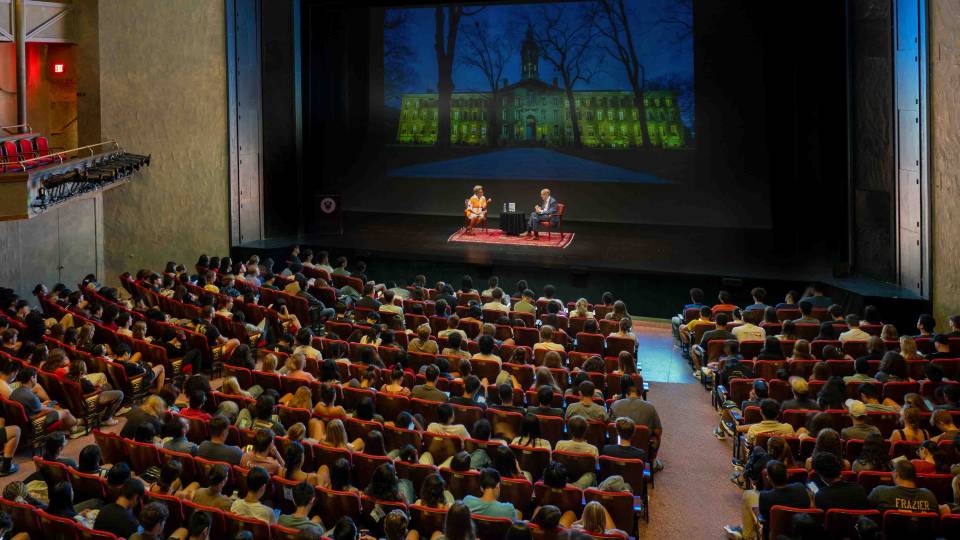
On Oct. 20, Eisgruber and Deborah Pearlstein (left), director of the Princeton Program in Law and Public Policy, engaged in a lively conversation with a capacity crowd in the community room of Princeton Public Library.
Classrooms that get free speech right
What’s working at Princeton, Eisgruber has told audiences — in particular in the classroom — are faculty members who “teach and model skills” that allow rigorous debate to take place with dignity and respect.
“I feel very strongly that universities, in order to fulfill their mission, both have to have vibrant free speech on their campuses and they have to be inclusive places where people from all backgrounds can flourish,” he said at the Washington event.
At his Princeton Public Library talk, he recalled the parent of a Princeton student he met recently whose conservative son took a class taught by poverty expert Matthew Desmond, known “for being on the political left,” Eisgruber said.
After a couple of classes, the parent told Eisgruber, the student was wondering to himself, “Should I really be here in this classroom, and am I going to be welcome?”
By the parent’s account, Eisgruber said, "Professor Desmond, unprompted, walked up to him and said, ‘I'm so glad that you are in this classroom. I want you to continue speaking up. You're really benefiting the class discussion.’
"Faculty members who can intuit things like that make a big difference,” he said.
After last week’s book talk for “Terms of Respect” at the art museum, sophomore Elaine Gao said that she had been eager to hear President Eisgruber speak because his book captures the essence of free speech at Princeton as she has come to know it and embrace it.
Gao said she set her alarm for when the tickets would become available.
Her zeal for free speech has been sparked in the classroom, she said — particularly in “Civil Liberties,” taught by Robert P. George, and in the team-taught Humanities Sequence, “where we always had dynamic debates despite our drastically different backgrounds.”
Gao also enjoys honing arguments sharpened by opposition as a member of the Princeton Debate Panel.
“To me, respectful listening starts at recognizing one’s interlocutor as a person,” Gao said. “Only then can genuine dialogue and the search for common ground take place.”