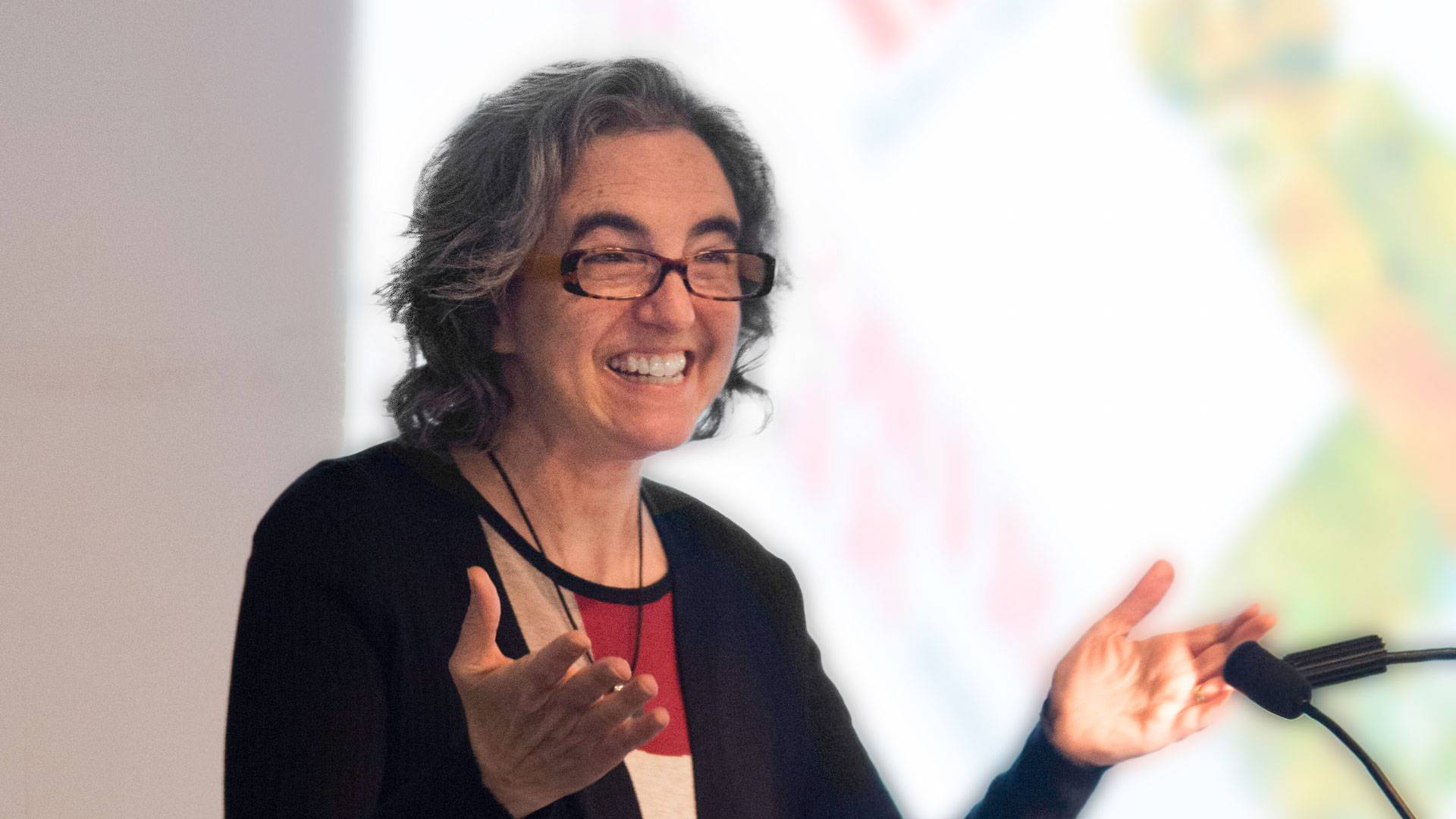
Alison Isenberg, distinguished urban historian and co-founder of Princeton-Mellon Initiative in Architecture, Urbanism and the Humanities, dies at age 63
Alison Isenberg
Professor of History Alison Isenberg, a distinguished scholar of urban life and co-founder of the Princeton-Mellon Initiative in Architecture, Urbanism and the Humanities, died Oct. 23. She was 63.
A public memorial and celebration of Isenberg’s life will be held at 11 a.m. Saturday, Dec. 6, at the University Chapel.
Isenberg joined the Princeton faculty in 2010 and helped lead Princeton’s teaching and research in urban studies for more than a decade. She was known as an innovative collaborator who brought together faculty and students across disciplines, and as a scholar who made deep connections with the communities she studied, including Trenton, New Jersey, the site of her pioneering public humanities project on the uprisings of the 1960s.
“Beyond her role as a distinguished urban historian, Alison had a penchant for opening up academic spaces to new participants,” said Department of History Chair Angela Creager, the Thomas M. Siebel Professor in the History of Science.
Creager continued: "I witnessed this in her founding of the Princeton-Mellon Initiative in Architecture, Urbanism and the Humanities; her teaching and documentary filmmaking on urban history and public policy with Purcell Carson; and her pioneering work as a public historian excavating the long-term effects of social unrest and police violence in Trenton after the assassination of Martin Luther King Jr.”
“Alison helped people see the world as it could be, not just how it was,” said Erika Milam, the Charles C. and Emily R. Gillispie Professor in the History of Science. “My memories of working with her blend together into a montage of her inquisitive questions, enthusiasm for her students’ projects and infectious sense of joy.”
Robin Bachin, the Charlton W. Tebeau Associate Professor of History at the University of Miami, said Isenberg’s interdisciplinary work had wide and important impact.
“Alison’s scholarship has impacted so many fields, from urban history to historic preservation, art history to geography, and architecture to public policy,” said Bachin, who preceded Isenberg’s tenure as president of the Society for American City and Regional Planning History.
“Alison brought a practitioner’s sensibility to the study of urbanism,” Bachin continued. “She explored the multiplicity of factors that impact what policies get enacted, plans promoted and projects developed. Her scholarship amplified diverse community voices and showed how attention to local experiences can reshape larger national narratives of urban change.”
Isenberg was also an inspiring teacher and mentor to undergraduates and graduate students. She was honored in 2024 with Princeton’s Graduate Mentoring Award.
“Princeton has lost an incredibly bright light,” Associate Professor of History Rosina Lozano said. “Yes, for the current and future students who will not get to work with her, but also for all of us professors and staff who will never again run into her positive energy and care on campus. She created community and connected people. She will be greatly missed.”
A historian who connected urban studies, architecture, planning and more
At Princeton and beyond, Isenberg was passionate about connecting the study of history, urban studies, architecture, planning and design in innovative ways. In 2013, she became founding co-director of the Princeton-Mellon Initiative in Architecture, Urbanism and the Humanities, a multidisciplinary research, teaching and public-engagement program housed in the School of Architecture. Isenberg also served as director of Princeton’s urban studies program from 2012 to 2014.
“Alison’s work was critical in making Princeton a really dynamic place to study cities,” said Aaron Shkuda, project manager for the Princeton-Mellon Initiative. “Alison always fostered robust dialogue between scholars and students across disciplines. At Princeton, she helped create a place to study cities where the humanities stand on an equal footing with fields like architecture and planning and programs like environmental studies and gender studies.”
Sarah Lopez, a former Princeton-Mellon Initiative postdoctoral fellow who is now on the faculty at the University of Pennsylvania’s Stuart Weitzman School of Design, said Isenberg was an influential scholar in the field.
“Her work in urban history, from her books ‘Downtown America’ to ‘Designing San Francisco’ to her ongoing projects about Trenton, have become foundational pieces in so many undergraduate and graduate urban history classes, as well as classes in design schools that address the role of history in understanding how our cities have been shaped and who they serve,” said Lopez, an associate professor of city and regional planning.
Carla Yanni, distinguished professor of art history at Rutgers University and a former colleague, said Isenberg studied history to illuminate answers about society today.
Yanni said Isenberg’s early life had a “profound influence” on her approach to the field, noting that Isenberg’s mother was an architect and Isenberg worked in affordable housing, parks planning and historic preservation in New York City before becoming an academic.
“She had this interest in connecting history in a meaningful way to social issues of the present, whether that was cities, planning history, architecture, preservation issues, park design or main streets,” Yanni said. “She wanted to study the way in which people use spaces and how those spaces had meaning to people. It wasn’t a top-down kind of history. It was a history that started with people in specific places.”
Isenberg's 2004 book “Downtown America: A History of the Place and the People Who Made It” (University of Chicago Press) won several awards, including the Ellis W. Hawley Prize from the Organization of American Historians, the Lewis Mumford Prize from the Society for American City and Regional Planning History, and an Honor Book Award from the New Jersey Council for the Humanities. Her 2017 book, “Designing San Francisco: Art, Land, and Urban Renewal in the City by the Bay” (Princeton University Press) received the 2018 PROSE Award for Architecture and Urban Planning from the Association of American Publishers, among other honors.
Using history to help create a better future
Isenberg’s most recent book project, “Uprisings,” examines the life and death of Harlan Joseph, a 19-year-old Lincoln University student who was shot by police in 1968 during a period of civil unrest in Trenton that followed the assassination of Martin Luther King Jr.
Isenberg was completing the editing process before she passed away, said Isenberg’s husband, Keith Wailoo, Princeton's Henry Putnam University Professor of History and Public Affairs. He said “Uprisings” is expected to be published posthumously by Princeton University Press.
“My goal is to bring the book to the finish line. It is a crucial part of her legacy,” Wailoo said. “For her, history wasn’t merely concerned with the past. Her brand of history was active and engaged, closely involved in reshaping and creating a better future.”
“Uprisings” grew out of Isenberg’s longtime work on The Trenton Project with Carson, a documentary film specialist at the Princeton Humanities Initiative who conceived of the idea in 2012. The public project combined history and filmmaking and evolved over the years to create a feature-length documentary, archival research projects, undergraduate courses, public programs and community events.
“Together, we were able to ask questions that hadn’t yet been answered and show how history is relevant to the people who are living in Trenton today,” Carson said.
“The essential question of Alison’s work as a historian was always ‘How can I help?’” Carson continued. “How can history help in a sense of justice? How can history help provide deeper understanding? How can history provide more meaning in how we build civil society together?”
Through her extensive archival research for the Trenton Project, Isenberg helped the Princeton University Library acquire the photographic archives of The Trenton Times following the newspaper’s cessation of publication earlier this year.
Carson said she and Isenberg were also working with local officials to name a park in Trenton in Joseph’s honor.
“Alison made so much possible through her quiet and persistent enthusiasm,” Carson said. “During our many years of collaboration, she would remind me that even the smallest step is a step forward and all those steps add up to accomplish wonderful things.”
Earlier this year, Isenberg received a major grant from the Robert Wood Johnson Foundation to co-lead a new research project. The three-year study, “Truth and Repair: The History of Structural Racism in New Jersey,” partners scholars and students from Princeton, Rutgers and St. Peter’s universities with cultural institutions across the state.
A generous mentor with an “unflagging spirit”
Isenberg was also known as a generous mentor and passionate teacher.
“Despite her many research interests and obligations,” Lopez said, Isenberg’s “generosity of spirit, her large and open heart, and her interest in new and emerging scholars meant that Alison made time to cultivate and nurture a community of historians.”
Professor of History Beth Lew-Williams, the department’s director of graduate students, said graduate students “flocked” to Isenberg.
“She had an unflagging spirit,” Lew-Williams said. “She always seemed to have the perfect words of wisdom for how to craft a project or how to navigate academia. I think the students sensed how deeply she believed in them as historians and as people.”
Maia Silber, who is pursuing her Ph.D. in history, recalled Isenberg’s advice as she debated dissertation ideas.
“Alison and I took this long walk around Princeton, and she said something to the effect of, 'Any one of these projects is intellectually interesting and would make a good dissertation, but which is the one you really care about? Which is the one that you have to write right now?'” Silber said.
“She just really encouraged me to do work that aligned with my values, and that made me feel like I had the possibility of really contributing something to the world,” Silber continued. “That’s really an aspiration for my own career.”
Caroline West, who is also pursuing her Ph.D. in history, said she will greatly miss Isenberg’s “compassion, care, enlivening energy and generous spirit.”
“When I first embarked on dissertation writing this past summer, I wrote an early draft of my acknowledgments section to remember the magnitude of her impact — her faith in my promise, her mind-expanding questions, her uncanny knack for transforming the most amorphous ideas into viable research directions. I wrote then that she was ‘the greatest adviser one could ever ask for.’” West said. “She might have pressed, with her gentle incisiveness, for more precision in place of hyperbole. But she was, simply and plainly, the greatest.”
Isenberg had a similar impact on her undergraduate advisees, staying in touch with them as their lives and careers evolved in different directions.
“That was part of what made her so magical,” recalled Class of 2015 valedictorian Misha Semënov-Leiva, who is now the university architect for sustainability at Yale. “She created this cross-disciplinary space for students interested in urban studies. We are now architects, writers, filmmakers, but we all learned so much from Alison and her approach to researching and sharing urban history.”
Semënov-Leiva said he was honored when Isenberg asked him to provide illustrations for her book on San Francisco, his hometown. “To me, the relationship we had after graduation was just as important and meaningful,” he said. “It was a privilege that she asked me to contribute to her scholarship and that she considered me a colleague.”
Class of 2024 graduate Lena Hoplamazian recalled Isenberg as the perfect balance of “champion and challenger” while advising her senior thesis.
“Professor Isenberg left an indelible mark on the way I research and write, but perhaps most importantly, she asked me questions that I am still answering,” said Hoplamazian, who is currently pursuing a career in design. “Much like the history I studied with her at Princeton, Professor Isenberg’s guidance is not confined to my past; it remains an insistent part of my present, and a voice I will cherish and remember far into my future.”
Before joining the Princeton faculty, Isenberg served on the faculty of Rutgers University from 2001 to 2010. Prior to that, she taught at the University of North Carolina-Chapel Hill and Florida International University.
Kara Schlichting, an associate professor of history at Queens College, the City University of New York, said Isenberg pushed her to become a “better writer and thinker” while serving as her doctoral adviser at Rutgers.
“After graduate school, we collaborated on New York City field trips for her Princeton students, and it was a joy to see how she led by example. With smart observation, she inspired her students to ask questions and embrace curiosity about the city in the past and present,” Schlichting said.
Isenberg earned her bachelor’s degree in history from Yale University and her Ph.D. in history from the University of Pennsylvania.
She is survived by Wailoo and their daughters, Sahara Iman Wailoo and Myla Eleanor Isenberg Wailoo, a Class of 2024 graduate, as well as extended family. The family asks that contributions in Isenberg’s honor be made to the Rescue Mission of Trenton.
View or share comments on a memorial page intended to honor Isenberg's life and legacy.
Rebekah Schroeder contributed reporting for this story.